Desert Online General Trading LLC
Dubai, United Arab Emirates
Desert Online General Trading LLC
Dubai, United Arab Emirates

Full description not available

S**T
Outstanding guide to Polars for Python
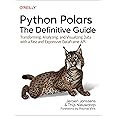
Fantastic! The Bible of Polars for Python. Polars is a new DataFrame library, anticipated to be the successor to pandas, the most commonly used Python library for data science. Python Polars: The Definitive Guide is an accessible, clear, and in-depth introduction to Polars for Python. The authors have written this guide with great care and with an eye to different kinds of reader, from data analyst, to data engineer. This book promises to be a classic in the next generation of fast and efficient tools for data science. I highly recommend the book to beginners and experienced data professionals!
A**N
Clear and comprehensive
I’ve been waiting for this book for a while and it does not disappoint. It’s a clear and comprehensive guide to Polars in Python. I like how it explains how Polars improves on Pandas to achieve its efficiency gains. I’m convinced and Polars is for sure my DataFrame library of choice now!
S**S
Excellent resource for anyone interested in data science/engineering
A colleague recently asked me to read this book to see what I thought due to an interest in data science/engineering (but far from experienced or proficient in it). My background is very much strong in software and platform engineering but data is semi-new to me which makes me think this review might be interesting to people. In a nutshell, I have very much fallen in love with Polars, largely as a result of this book but also because it's just great, and have used it on a few projects since in a matter of mere weeks since I read this book. This book got me started really quicklySo three questions I'm going to answer, one is what does Polars do, the next is why is Polars great and you should be interested in using it (or not as the case may be) and if the answer to that is yes, why this book will get you off the ground very quickly (assuming at least a passing knowledge of Python and Jupyter notebooks say).So should you be interested in Polars first? Have you ever used Pandas and found it useful? Or have you ever wished you could do Excel but have the power of Python and the ability to do _much_ more data in turn? Then Polars is something you should probably be interested in. Polars would let you take a hundred million row spreadsheet, pull out certain rows that satisfy certain criteria and let you plot graphs based on that new data while you're experimenting to find patterns. This might sound very much a data scientists realm, but I've found even in software or platform engineering I've been using this to benchmark software now I have this tool to hand. Could of course be that now I have this hammer everything looks like a nail and I'm finding excuses to use it, but it is very cool in my defence.OK, so why is Polars great? Simply put, speed, capacity, speed, user experience and speed pretty much. As an example, I only recently learned how to use Pandas (without reading a book on it, at least not for a while) and had managed to use it for a personal project that was dealing with about 350m rows of pretty much 5 columns of text data. To get Pandas to work with this I was splitting CSV files (I know I could have used other better formats but I wanted to be able to grep this quickly without firing up Jupyter notebooks) into 100 smaller files and processing them because Pandas would just grind to a halt and take forever to read it in. In Polars it's seconds to do either, and not that many seconds. Related to this, as a result I can use this for processing much more data, this will load 300m rows in a similar time I could get pandas to do like 3 million (possibly even faster) and seemed to scale linearly where Pandas scaled badly from there. I'm no longer splitting my big CSV file as there's no need to thanks to the speed of Polars.Another good reason I love Polars is I find it a lot more intuitive than Pandas. With Pandas I find I'm having to google (or ask AI) how to do something every time I want something new and enough things exist on the internet that this tends to get answers reasonably fast. With Polars on the other hand it's already fairly obvious. To filter a dataframe I use `.filter` on it. It's very intuitive for anyone used to working with SQL say, you've got your "group by" type of tools. Of course if you're already very familiar with Pandas there is more to learn, which leads me nicely onto my last question.So why this book? This book strikes a really nice balance between a reference and a tutorial that you want from a book like this, one of the better balances I've seen in fact. It basically contains everything you need to know to get started in the first 5 chapters which I read thoroughly and tested things out. After maybe a couple of days of reading these chapters I pretty much skimmed the rest of it as that's more reference type material. It's not so overly dense as to replace the Polars documentation (as there's a lot of functions) but it covers the most commonly used ones. It also does an excellent job of explaining (of which I've given a very small flavour of in this review) why Polars might be interesting to you how to get started. Within a week of starting reading this book I had fully refactored the project I mentioned to use only Polars and it's just so much faster now and so much quicker to experiment with.
Trustpilot
3 weeks ago
3 days ago